Bowers Family 1757 – 1955 Part 3

Charles Bowers

Charles Bowers

Charles was born in 1828 in Terrington-St Clements, Norfolk, England to Bonnet Bowers and Eliza Linford.[1]  Charles’ mother died when he was just a little over two years old.[2]  Charles grew up in England with his father and brothers.  One wonders if Bonnet had help with the care of the children.  There were aunts and uncles living in Terrington-St. Clements perhaps they helped.

Charles left England when he was just 21 years old. He left Liverpool, England on February 1, 1851 with his father Bonnet Bowers aboard the sailing ship Conqueror of New York.[3]   If Charles had friends or family already in the United States they might have paid for his passage.  If his passage was not previously paid he would have to pay his passage and make the best bargain he could with the passenger-brokers.  The competition in this trade was very great, and fares varied from day-to-day, and even from hour to hour, sometimes as high as 5 pounds per passenger in the steerage and sometimes as low as 3 pounds 10 shillings.[4]

Charles’ experience immigrating to the United States was probably much like the following description of the typical emigrants experience leaving England through Liverpool.  “Notices were placed though out Liverpool with dates of sailing.  Most of the ships were owned and operated out of New York.   The average number of steerage passengers accommodated by most ships at that time was 400, but some had room for double that amount.  After the emigrant had chosen the ship that he would sail on, he had to bargain with the “man-catchers” a class of persons who received commission from the passenger- brokers for each emigrant they brought to the office of the passenger-broker.

The emigrant’s next duty was to present himself to the medical inspector.  A medical practitioner appointed by the emigration office of the port had to inspect the passengers to check for contagious diseases.  When the emigrant and his family had undergone this process, their passage-ticket was stamped, and they had nothing further to do until it was time to board.

The scene at the Waterloo dock in Liverpool, where all the American sailing ships were stationed was very busy at all times, but on the morning of the departure a large ship full of emigrants was particularly exciting and interesting.  Many of the emigrants boarded twenty-four hours before departure bringing quantities of provisions, although the government supplied the emigrants with liberal provisions to keep them in good health and comfort.

The following is the list of provisions provided by the government per week.

2 and ½ lbs of bread or biscuit

1 lb wheaten flour

5 lbs oatmeal

2 lbs rice

2 oz tea

½ lb sugar

½ lb molasses

3 quarts of water daily

On the day before sailing and during the time that a ship may be unavoidable detained in dock, some of the immigrants played the violin or bagpipes for their fellow passengers.   Young and old alike would dance and party.

A large number of spectators were at the dock-gates to witness the final departure of the ship full with anxious immigrants.  As the ship was towed out hats were raised, handkerchiefs waved, and people shouted their farewells from shore and the emigrants waved back from the ship.  It was at this moment emigrants realized this would be their last look at the old country.   A country in all probability associated with sorrow and suffering, of semi-starvation, never-the-less it was a country of their fathers, the country of their childhood, however little time was left to indulge in these reflections.

The ship was generally towed by a steam tug five or ten miles down the Mersey.  During this time the search for stowaways is done and a roll-call of passengers.  All passengers except those in state cabins were assembled on the quarter-deck.  The clerk of the passenger-broker, accompanied by the ship’s surgeon called for tickets.  A double purpose was answered by the roll-call, the verification of the passenger-list, and the medical inspection of the emigrants, on behalf of the captain and owners.  The previous inspection on the part of the governor was to prevent the risk of contagious disease on board.  The inspection on the part of the owners is for a different purpose.  The ship had to pay a poll tax of $1.50 per passenger to the State of New York; and if any of the poor emigrants were helpless and deformed, the owners were fined in the sum of $75.00 for bringing them and were compelled to enter in a bond to New York City so that they did not become a burden on the public.  The emigrants then settle in for the long voyage across the Atlantic Ocean.[5] After almost 3 month of sailing across the ocean, Charles arrived at the Port of New York on April 21, 1851.[6]  Before 1855 there was no immigrant processing center.  The shipping company presented a passenger list to the Collector of Customs, and the immigrants made whatever customs declaration was necessary and went on their way.’[7]

Robert and his wife, Rhoda, followed to the United States in November 1851 aboard the ship Emma Field.[8] Robert, his wife, and Bonnet settled in Syracuse, New York[9].  At this time, I cannot find when Richard came to the United States, however he is found living in Syracuse, New York in 1870[10]

In 1855, just one year after Charles arrived in Ottawa, it became a chartered city.   “Ottawa, Illinois is situated at the junction of the Fox and Illinois rivers, nearly the geographical center of LaSalle County.  The Fox enters the Illinois from the northeast and with its rapid currents feeds the Chicago and Illinois Canal, which follows the banks of the Illinois River.  In 1854 Ottawa had about 4,000 to 6,000 inhabitants.  The bridge over the Illinois River was under constriction connecting South Ottawa with the main city on the North.  Ottawa was and still is the LaSalle County seat.  In 1854 Ottawa had a mill on the Illinois River that turned out 100 barrels of flour per day.  Ottawa also had a foundry, two large machine shops, and other large manufacturers.” [11]

The same year(1854) that Charles came to Ottawa, he applied to become a United States Citizen in the LaSalle County Circuit Court. 12]   I often wondered what brought Charles to Ottawa, Illinois when it appears that his brothers and father stayed in New York.  I recently found that his step-brother William Linfor(d) was living in Ottawa, Illinois in 1854.[13]  You can read my post “Finding Brother William” published November 24, 2012 on this blog.  I assume that Charles came to Ottawa because he knew William Linfor.                      

Statue of Lincoln-Douglas Debate

Statue of Lincoln-Douglas Debate

On August 21, 1858 the first Lincoln-Douglas debate took place in Ottawa at the stand in Washington Park.[14]  I wonder if Charles attended and what his thoughts were about the two men.  He was not yet a United States citizen so he could not vote.  He became a naturalized citizen of the United States in January 1859.  He signed his naturalization papers with an X indicating he could not write.[15]

In 1860 Charles is found living in Lisbon, Kendall County, Illinois working on a farm and living with a family by the name of Leach.[16]  Charles bought a house In 1868 on the corner of Chapel and York Streets (543 Chapel Street) in Ottawa, Illinois for $1,000 cash from William K and Ellen M. Stewart of Ottawa, Illinois.  The house sits on a high bluff across the street from the Fox River.  It is located in a rather well-to-do area of Ottawa surrounded by Victorian houses.  Charles’ house is rather modest compared to houses around it.[17]  The house had living room, dining room, kitchen, parlor, storage room, and one bedroom on first floor.  The second floor had four bedrooms and bath (bath may have been added later).[18]

In December 1868 Charles married Alexena Frazer.[19]  They had five children Richard, Elizabeth, Robert, Genevieve, and Ethelyn.[20]   There may have been two children who died as infants.  According to Ottawa Avenue Cemetery records there is an E. E. and a J.A. Bowers buried in grave one.[21]

Charles worked as a janitor for the East Ottawa Public School.[22]  He and Alexena lived at 543 Chapel Street in Ottawa.[23]  He was a member of the Independent Order of the Odd Fellows for over 30 years.  He was a kind-hearted man, patient with children and liked by everyone.[24]  Charles died in 1897 and is buried in the Ottawa Avenue Cemetery, in Ottawa, Illinois.[25

Bowers' Family Headstone

Bowers’ Family Headstone

Copyright © 2013 Gail Grunst                        


[1]Baptism for Charles Bowers baptized on 2 October 1828; Register of Baptisms in the Parish of Terrington St. Clements, Norfolk, England; 1813 – 1841 manuscript on microfilm #13640109 Item 3; Utah: filmed by the Genealogical Society, Salt Lake City, Utah at Wisbech and Fenland Museum, Cambridgeshire, England.

[2] Burial record for Eliza Bowers (wife of Bonnet Bowers) buried on 22 January 1831. Church of England, Parish Church of Terrington St. Clements, Norfolk, England;  Terrrington St. Clements Parish Register Burials 1813 – 1856; manuscript on microfilm #13640109 Item 8; Utah:  filmed by the Genealogical Society, Salt Lake City, Utah 1988 at Wisbech and Fenland Museum, Cambridgeshire, England.

[3]Year: 1851; Arrival: New York, United States; Microfilm Serial: M237; Microfilm roll M237_107; Line: 26; List number: 1664. Ancestry.com. New York Passenger Lists, 1820-1957 [database on-line]. Provo, UT, USA: The Generations Network, Inc., 2006. Original data: Passenger Lists of Vessels Arriving at New York, New York, 1820-1897; (National Archives Microfilm Publication M237, 675 rolls); Records of the U.S. Customs Service, Record Group 36; National Archives, Washington, D.C.

[4] GEN UKI UK and Ireland Genealogy web site.  Extracts from an article printed in the Illustrated London News on Saturday July 6th 1850. It is a contemporary account of the procedure of Emigration from the port of Liverpool to the New World and the Colonies.

[5] GEN UKI UK and Ireland Genealogy web site.  Extracts from an article printed in the Illustrated London News on Saturday July 6th 1850. It is a contemporary account of the procedure of Emigration from the port of Liverpool to the New World and the Colonies.

[6] Year: 1851; Arrival: New York, United States; Microfilm Serial: M237; Microfilm roll M237_107; Line: 26; List number: 1664. Ancestry.com. New York Passenger Lists, 1820-1957 [database on-line]. Provo, UT, USA: The Generations Network, Inc., 2006. Original data: Passenger Lists of Vessels Arriving at New York, New York, 1820-1897; (National Archives Microfilm Publication M237, 675 rolls); Records of the U.S. Customs Service, Record Group 36; National Archives, Washington, D.C.

[7] GEN UKI UK and Ireland Genealogy web site.  Extracts from an article printed in the Illustrated London News on Saturday July 6th 1850. It is a contemporary account of the procedure of Emigration from the port of Liverpool to the New World and the Colonies.

[8] Year: 1851; Arrival: New York, United States; Microfilm serial M237; Microfilm roll: M237-107; Line: 26; List number 1664.  Ancestry.com. New York Passenger Lists, 1820-1957 [database on-line].  Provo, UT, USA: The Generations Network, Inc., 2006 Original data: Passenger Lists of Vessels Arriving at New York, New York, 1820-1897; (National Archives Microfilm Publication M237, 675 rolls); Records of the U.S. Customs Service, Record Group 36; National Archives, Washington D.C.

[9] Year: 1860, Census Place: Onondaga, Onondaga, New York, Roll: M653_829, Page 579; Image: 367. Ancestry.com. 1860 United States Federal Census [database on-line]. Provo, UT, USA. The Generations Network, Inc., 2004. Original data: United States of America, Bureau of the Census. Eighth Census of the United States, 1860.  Washington, D.C.: National Archives and Records Administration, 1860. M653, 1438 rolls.

[10]Year: 1870 Census Place: Syracuse Ward 7, Onondaga, New York; Roll M593_1063; Page: 464; Image: 239. Ancestry.com. 1870 United States Federal Census [database on-line]. Provo, UT, USA: The Generations Network, Inc., 2003. Original data: 1870 United States Ninth Census of the United States, 1870. Washington D. C. National Archives and Records Administration, M593, RG29. 1761 rolls.

[11] Ottawa Old and New: A Complete History of Ottawa Illinois 1823 – 1914 (Ottawa, Illinois: Republican – Times Ottawa, 1912 – 1914), p. 39.

[12] Declaration of Intent (naturalization) for Charles Bowers, LaSalle County, Illinois,  Circuit Court, LaSalle County, Illinois Courthouse, Ottawa, Illinois; Book 2, Pg. 227.

[13]  (Google eBook) (Chicago: Lewis Publishing Company, 1900), p. 227. 

[14] Ottawa Old and New: A Complete History of Ottawa Illinois 1823 – 1914 (Ottawa, Illinois: Republican – Times Ottawa, 1912 – 1914), p. 45.

[15] Final naturalization record for Charles Bowers.  LaSalle County Illinois, Circuit Court LaSalle County, Illinois  Court House, Ottawa, Illinois; Book E, Pg. 85.

[16] Ancestry.com 1860 United States Federal Census [database on-line], Provo, UT, USA:  The Generations Network, Inc., 2004.  Original data: United States of America, Bureau of the Census, Eight Census of the United States, 1860, Washington, D.C.: National Archives and Records Administration 1860, M653.               

[17] Author’s personal view of the house after visiting the area and seeing the house first hand in July of 2008.

[18] Probate File of Elizabeth A. Bowers Record A-6 page 176.  In possession of the LaSalle County Genealogical Guild, 115 Glover W. Glover, Ottawa, Illinois.

[19] Marriage License and certificate for Charles Bowers and Alexena Frazer.  License issued November 25, 1868, office of the clerk of the county, LaSalleCounty, Ottawa, Illinois.  Marriage date December 2, 1868 by Abraham R. Moore, Minister of the Gospel, filed with the LaSalle Illinois, CountyClerk office, LaSalle County Courthouse, Ottawa, Illinois.

[20] Year: 1880; Census Place: Ottawa, La Salle, Illinois; Roll T9 223: Family History Film 1243112; Page 516.10000, Enumeration District 81; Image: 0553.

[21] Ottawa Avenue Cemetery records; Ottawa, LaSalle County, Illinois, Record number 8539, Cemetery Card CCY-TS, Burial location OT18-7

[22] Year: 1880; Census Place: Ottawa, La Salle, Illinois; Roll T9 223: Family History Film 1243112; Page 516.10000, Enumeration District 81; Image: 0553.

[23] Ottawa Illinois City Directories 1866 – 1912.

[24] Obituary for Charles Bowers: Republican Times (Ottawa, LaSalle County, Illinois) February 18, 1897.

[25] Ottawa Avenue Cemetery Records: Ottawa, LaSalle County, Illinois. Record number 8539, Cemetery Card CCY-TS, Burial location OT18-7

Aunt Agnes a Love Story

Art and Agnes

Art and Agnes

Aunt Agnes was one of my grandmother’s three aunts.  Agnes Reinhardt was born in 1891 in Ottawa, LaSalle, Illinois.[1]  She was the youngest of seven children.[2]  She was only seven years older than her niece, my grandmother.[3]  Agnes grew up in Ottawa Illinois with her parents, brothers, and sisters.  Aunt Agnes is listed as living in Ottawa on the 1910[4] census and in a 1911 city directory,[5] after that I lose her for a few years.  In 1920 at age 28 she married Arthur Lightfoot in Detroit, Wayne, Michigan.[6]  He lists his occupation on the marriage record as a Traveler.[7]  The first thing that came to my mind was, “What kind of occupation was a traveler?”  I thought maybe he was a gypsy (just kidding).  I think it was a term used back then for a traveling salesman.  Later census records list him as a salesman.[8]  I have no idea how they met or why they got married in Detroit.  His resident on the marriage record is listed as Indianapolis, Indiana and hers is Ottawa, Illinois.[9] On the 1930 and 1940 census records, they are living in Chicago, Illinois.[10] [11]  Also on his WWI and WWII draft cards he is living in Chicago.[12] [13]  At some point in time, they moved to Hartford, Connecticut.  Arthur was born and raised in Connecticut.[14] When I was a child, I knew that Aunt Agnes lived in Connecticut.  Aunt Agnes and Art came to visit us a couple of times from Connecticut.  Arthur died in 1957 in Connecticut,[15] and some time after his death, Agnes moved back to Chicago.

Aunt Agnes would come to visit us on some weekends and holidays.  In her old age, Aunt Agnes was flamboyant.  She wore a lot of makeup, her hair was bleached blond, and she wore a lot of jewelry.  The jewelry had big stones and was gaudy.  One time I was looking at a bracelet she had on with big stones.  She asked me if I liked it.  I didn’t want to insult her so I said, “yes.”  She took off the bracelet and handed it to me, and told me I could keep it.  I was around 13 years old at the time.  I thanked her, but knew I would never wear it.  I didn’t like it.  After she had gone home, my mother confiscated it, and put in her jewelry chest.  The bracelet was in my mother’s jewelry chest for years.  I don’t know what ever became of it.

Aunt Agnes would come out to our house by train or bus and sometimes we would drive her back to Chicago.  One time when we drove her back, when we got to Clark and Belmont near where she lived, she said, “Now I can relax, I am home.”  I couldn’t understand why she couldn’t relax at our house.  Our house was in the suburbs and it was nice, quiet, and safe compared to the hustle and bustle of the city.  I thought it would be easier to relax in the quiet and calm of the suburbs.  Until I started delving into her life, I thought she and her husband always lived in Connecticut after they were married.  I also had the impression that they were rich.  Not sure how I came to these conclusions.  So I was surprised to learn that she lived in Chicago, most of her married life. I doubt that he became rich as a salesman.

I think Aunt Agnes probably had the most normal life of the three sisters.  I gave this posting the title Aunt Agnes a love story because I truly believe that Aunt Agnes loved her husband and he loved her. She talked about Art all the time.  I hope they loved each other, they were married 37 years.  They had no children.  I have wondered if Aunt Agnes had a previous marriage, but haven’t been able to find any other marriage records for her.  I found no illegitimate children or any thing unusual.  I believe she led a very ordinary life and loved her husband.   She died in Chicago, IL in 1978 at 87 years old.[16]  She had a good long life, and I am glad I got to know her before she died.  As always, I wish I had asked her more questions about her life and family, but I wasn’t interested in Genealogy at that time.  So now I can only go on a few memories and documents.  I hope I did her justice today, since I had so little to go on.

Copyright © 2013 Gail Grunst


[1] “Michigan, Marriages, 1868 – 1926,” index and images, FamilySearch (https://familysearch.org/pal:/MM9.1.1/N319-11L) Arthur A. Lightfoot and Agnes B. Reinhardt 12 April 1920.

[2] “United States Social Security Death Index,” FamilySearch (familysearch.org/pal:/MM9.1.1/J2RS-YPG) Agnes Lightfoot, January 1978

[3] State of Illinois, Department of Public Health, Division of Vital Statistics and Records; Delayed Record of Birth, State file # 204857; Ottawa, LaSalle, Illinois; Helen Dorothy Bowers, December 3, 1898.

[4] Year: 1910; Census Place: Ottawa Ward 5, La Salle, Illinois; Roll T624_301; Page: 11A’ Enumeration District: 0129; Image:  ; FHL microfilm:1374314.  Ancestry.com.  1910 United States Census [database on-line]. Provo, UT, USA:  Ancestry.com Operations Inc. 2006.

[5] McCoy Ottawa City Directory 1911 – 1912 The McCoy Directory Company, Publishers and Compilers, 411 Brown Building, Rockford, Illinois. Agnes Reinhardt page 140.  Ancestry.com. U. S. City Directories, 1821 – 1989 [database on-line].  Provo, UT, USA:  Ancestry.com Operations, Inc., 2011.

[6] Michigan, Marriages, 1868 – 1926,” index and images, FamilySearch (https://familysearch.org/pal:/MM9.1.1/N319-11L) Arthur A. Lightfoot and Agnes B. Reinhardt 12 April 1920.

[7] Ibid.

[8]Ancestry.com. 1930 United States Federal Census [database on-line]. Provo, UT, USA: Ancestry.com Operations Inc, 2002.  Original data: United States of America, Bureau of the Census.Fifteenth Census of the United States, 1930. Washington, D.C.: National Archives and Records Administration, 1930. T626, 2,667 rolls.

[9]  “United States Census, 1940,” Index and images, FamilySearch (https://familysearch.org/pal:/MM9.1.1/K493-88Y) Arthur Lightfoot, Ward 48 Chicago City, Cook, Illinois, United States; citing enumeration district (ED) 103-3087, Sheet #B, Family 123, Nara digital publication T627, roll 1018.

[10] Ancestry.com. 1930 United States Federal Census [database on-line]. Provo, UT, USA: Ancestry.com Operations Inc, 2002.  Original data: United States of America, Bureau of the Census.Fifteenth Census of the United States, 1930. Washington, D.C.: National Archives and Records Administration, 1930. T626, 2,667 rolls.

[11] “United States Census, 1940,” Index and images, FamilySearch (https://familysearch.org/pal:/MM9.1.1/K493-88Y) Arthur Lightfoot, Ward 48 Chicago City, Cook, Illinois, United States; citing enumeration district (ED) 103-3087, Sheet #B, Family 123, Nara digital publication T627, roll 1018.

[12] “United States, World War I Draft Registration Cards, 1917- 1918,” index and images.  FamilySearch(https://familysearch.orgpal:/MM9.1.1/K6DX-DDG) Arthur Atkins Lightfoot, 1917-1918.

[13]“United States, World War II Draft Registration Cards, 1942,” index and images, FamilySearch(https://familysearch.org/pal:/MM9.1.1/V1KW-8GM) Arthur Atkins Lightfoot, 1942.

[14] “United States Census, 1900,” index and images, FamilySearch (https://familysearch.org/pal:/MM9.1.1/M9QK-KZZ) Arthur A. Lightfoot in entry for Arthur Lightfoot, 1900.

[15] “Connecticut, Death Index, 1949 – 2001.” Index, FamilySearch (https://familysearch.org/pal:/MM9.1.1/VZPP-1XL) Arthur A Lightfoot, 1957.

[16] “United States Social Security Death Index,” FamilySearch (familysearch.org/pal:/MM9.1.1/J2RS-YPG) Agnes Lightfoot, January 1978.

Aunt Emma’s Two Lives

Emma age 19

Emma age 19

My grandmother had three Aunt’s, Aunt Emma, Aunt Liz, and Aunt Agnes.  Each one had an interesting life.  I wrote about Aunt Liz in my blog dated 4/13/2013.  Today I am writing about Aunt Emma.

Emma Reinhardt was born on June 6, 1885 in Illinois.,[1] [2]  Emma was raised in Ottawa, LaSalle, Illinois along with her two brothers and four sisters.  Not much is known about Emma’s early life.  In 1910 at age 25 she married Dr. Fredrick L. Orsinger[3] who was 33 years her senior.[4]  He had been married before and had five children with his first wife who died in 1903.[5]

Fredrick L. Orsinger came to the United States from Germany in 1871.  He arrived in Chicago on the same day as the Chicago Fire.  He decided not to stay in Chicago at this time and went to LaSalle, Illinois to work in his Uncle’s bakery.  He later opened a pharmacy in LaSalle and practiced medicine.  He studied medicine and surgery in Zurich, Switzerland and Paris, France.   He later spent five years studying medicine at the College of Physicians and Surgeons of Chicago, and later had a years experience working at Cook County Hospital. [6]   He had quite a colorful life too.  I am not going to write about it at this time as I would like to concentrate on Emma’s life.  I will write about his life in more detail at another time.

My grandmother had told me that the Reinhardt’s and Orsinger’s were friends.  I know there was an Orsinger’s Bakery in Ottawa.  I don’t know if they had another one in LaSalle or if the source is wrong about the location of the bakery.  However, Emma would have not been born yet when he came to LaSalle County.  By the time she was old enough to get married he was living in Chicago.  So how they got together is unknown.  I’m guessing that they knew each other because the families were friends.  I still can’t help but wonder how her family felt about the age difference, and how his children felt as some were older than Emma.  My grandmother would say with disgust in her voice, “Aunt Emma married old Doc Orsinger.”  They lived in Chicago and he practice medicine in Chicago. Dr. Orsinger died in 1925.[7]

In 1933 Emma married Iber Mataway in Chicago.[8]  He was from Iran and changed his name when he was naturalized from Isaac Abraham to Iabry Abraham Mataway.[9]  They must have led a quiet life.  I can’t find them in many records.  He was 12 years her junior.[10]  She went from some way older than her to someone quite a bit younger than her.

I’ve had a hard time finding them on any census records.  I do know they lived on a farm in Wisconsin.  I also know they lived in an apartment in Chicago, Illinois.  My mother loved Aunt Emma and she would stay with her sometimes in Chicago and on the farm in Wisconsin when she was young.  I believe they lived in Chicago, then moved to the farm in Wisconsin, and then moved back to Chicago.

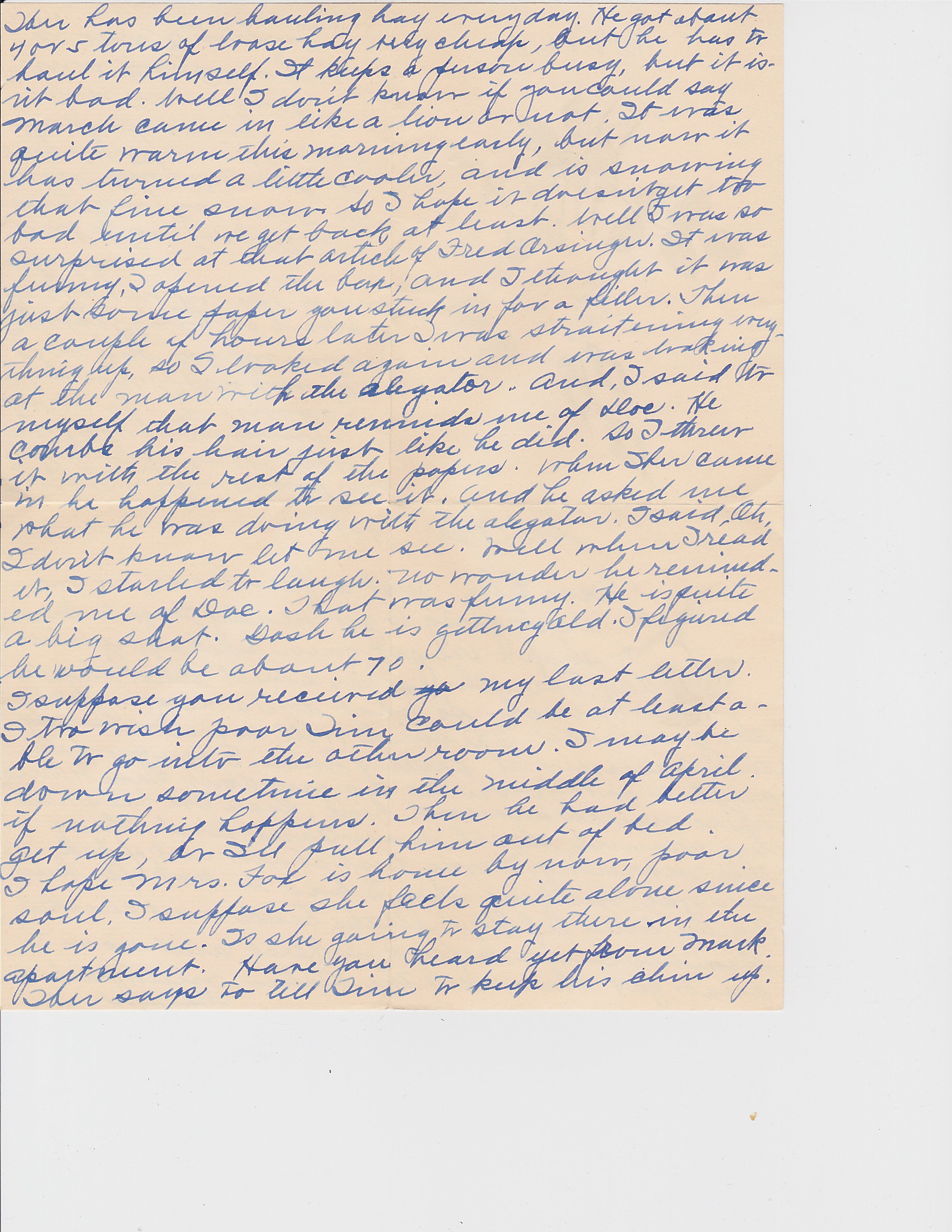
I have a letter that Emma wrote to her sister Liz.   I will try to transcribe it as written with mistakes and all. 

Sat Mch. 1 – 1947 

Dear Eliz,

            Just a few lines, as we are trying to get ready to go to Saxon to shop.  We got your package yesterday.  Everything was swell.  And thanks so much.  So what do I owe you for groceries.  The shirts will come in handy this summer at laying time. Even good enough to go to town in as you don’t have to dress up so much around here.  Gosh, I’ve been rushing around, the oil man came first thing this morning, I was just about out of bed.  Iber was milking, then I had to look after him.  By the time he filled all the tanks and checked them, Iber came in for breakfast, and now I just got thru with the dishes, milk pails, and strainers.  Iber has been hauling hay everyday.  He got 4 or 5 tons of hay very cheap, but has to haul it himself.  It keeps a person busy, but it isn’t bad.  Well, I don’t know if you can say March came in like a loin or not.  It was quite warm this morning, but now it has turned a little cooler and is snowing that fine snow.  So I hope it doesn’t get too bad until we get back at least.  Well, I was so surprised at that article of Fred Orsinger.  It was funny, I opened the box and I thought it was just some paper you stuck in for a filler.  Then a couple of hours later, I was straightening everything up, so I looked again and was looking at the man with the alligator.  And, I said to myself that man reminds me of Doc.  He combs his hair just like he did.  So I threw it in with the rest of the papers.  When Iber came in he happened to see it, and asked me what he was doing with an alligator.  I said oh I don’t know let me see.  Well, when I read it, I started to laugh.  No wonder he minded me of Doc.  That was so funny.  He is quite a big shot.  Gosh he is getting old.  I figured he would be about 70. 

I suppose you received my last letter.  I too wish poor Tim could at least be able to go into the other room.  I may be down sometime in the middle of April if nothing happens.  Then he had better get up or I’ll pull him out of bed.  I hope Mrs. Fox is home by morn, poor soul.  I suppose she feels quite alone since he is gone.  Is she going to stay there in the apartment.  Have you heard yet from Mark.  Iber says to tell Tim to keep his chin up.

I do wish Iber could make a trip to Chicago.  Well, we’ll see how things turn up.  He needs a change.  I feel guilty when I go all the time.  I guess Clara is going to stay in her apt. for a while.  Well, if I have forgotten anything I’ll write it next time.  I must get ready.  Iber is almost thru shaving. 

Love to you both and God Bless you as ever.  Emma & Iber 

The Fred Orsinger she mentions in the letter is the son of her late husband.  I am posting the original letter here.

Letter from Aunt Emma 2

Letter from Aunt Emma 3

Letter from Aunt Emma 1Letter from Aunt Emma 4

I remember visiting Aunt Emma a couple of times in her apartment in Chicago.  She made a doll bed for me out of a wooden cigar box.  I wish I had a picture of it.  She painted it white and it had a headboard.  The legs were cloths pins (the old fashioned wood ones) cut down so only the top curved part was used for the legs.  She made a little mattress and pillows.  She made a blanket and crocheted a bedspread for it.  I loved it and had it for a long time.  I found instructions for making one on the Internet, and also found pictures, but none that looked as good as mine.  Mostly what I remember of Aunt Emma was a very nice old lady and the doll bed.

I think the first half of her life was probably more eventful than the last half.  Being married to “Old Doc Orsinger” must have been very eventful from some of the things I have read about him.  Like I said, that is for another time.  The second half of her life being married to Iber, her life was quiet.  Reading the letter, her life was just about the ordinary every day things like the weather, washing dishes, milk pails and strainers.  The exciting time was going to town.  I wish I knew more about her life.  As far as I know, she never had any children to carry on her legacy.  I hope I helped a little to carry on her legacy today.

Aunt Emma, my mom, Aunt Liz 1943

Aunt Emma, my mom, Aunt Liz 1943

Emma died on August 18, 1956, and Iber died in 1974.

Copyright © 2013 Gail Grunst


[1] Emma Reinhart’s birth date June 6 came from Helen Kaiser’s (her niece) date book.

[2] 1900 United State Census entry for Emma Reinhardt.  Original data:  United States of America, Bureau of the Census.  Twelfth Census of the United States, 1900.  Washington, D.C.: National Archives and Records Administration 1900 T623 1854 rolls.  Ancestry.com 1900 United States Federal Census.  [database on-line]. Provo, UT, USA:  Ancestry Operations, Inc.,2004.

[3] Joseph Seymour Curry, Chicago: its history and its builders, a century of marvelous growth, volume 4 (Chicago:  The S. J. Clarke Publishing Company, 1912), Pgs. 624 – 628. Digitized by Google.

[4] Ibid.

[5] Ibid.

[6] Ibid.

[7] Find-a-grave website at www.findagrave.com

[8]Ancestry.com.  Cook County, Illinois Marriage Index, 1920 – 1960  [database on-line]. Provo, UT, USA:  Ancestry.com Operations Inc, 2008.

[9] Naturalization Record for Iabry Abraham Mataway name chanced at naturalization from Isaac Abraham. Ancestry.com. US Naturalization Record Indexes, 1791 – 1992 (Indexed in World Archive Project) [database on-line].  Provo, UT, USA:  Ancestry Operations, Inc., 2010.  Original data: Selected U.S. Naturalization Records.  WashingtonD.C.: National Archives and Records Administration.

[10] Ibid.